The Eurocode generation 2 changes don’t represent a complete overhaul, but they do introduce meaningful shifts in how we model structural behaviour. Many of the changes look small on paper yet have a real impact in practice. Here are 4 areas to keep on your radar.
1. Deflections: A Shift Towards Consequences
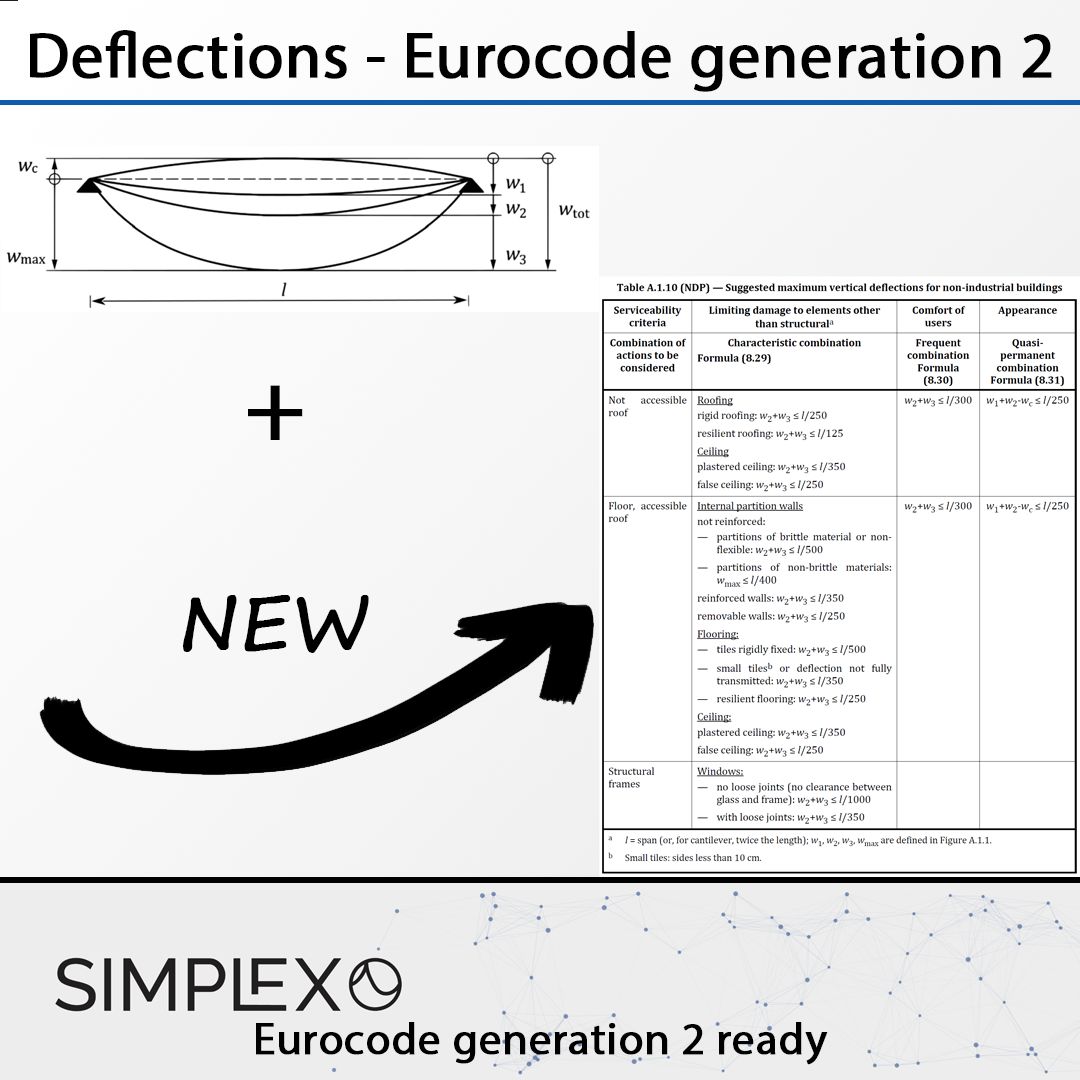
One of the clearest updates is how deflections are framed. The new Eurocode puts stronger emphasis on why deflections matter, grouping them by consequences:
- Appearance: (w₁ + w₂ − w_c)
- Comfort: (w₂ + w₃)
- Damage: (w_max, w₂ + w₃)
So far, so logical.
However, once non-linear behaviour enters the picture, things get less intuitive. The code still assumes a largely linear workflow: run the analysis once, then adjust results using factors.
That approach breaks down for non-linear systems. Scaling deflections across load cases no longer makes sense, meaning engineers are pushed toward alternative methods, often more complex than expected.
2. Snow Loads: From One-Size-Fits-All to Context-Aware
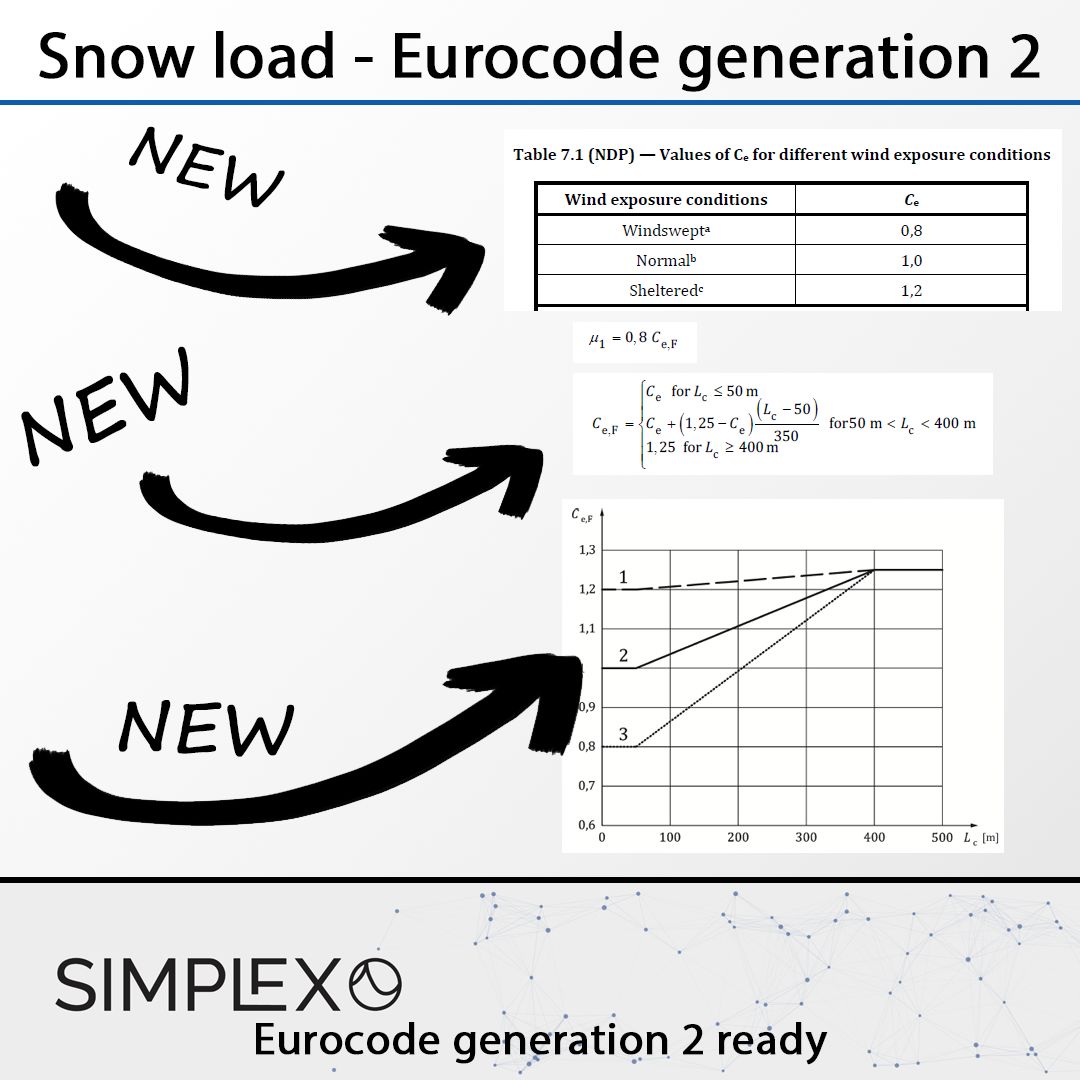
Flat roof snow loads are no longer treated as a fixed default.
- Old: μ₁ = 0.8
- New: μ₁ = 0.8 · Cₑ,F
This introduces sensitivity to exposure, roof size, and proportions.
What does that mean in practice?
- Small, windswept roofs → lower loads
- Larger roofs → potentially higher loads (up to +25%)
Examples:
- Normal small roof: μ₁ = 0.8 → no change
- Windswept roof: μ₁ = 0.64 → ~20% reduction
- Very large roof: μ₁ approaching 1.0 → up to ~25% increase
The result is a more nuanced, but also more input-heavy, approach. And with national annexes still to define specifics, there’s still some uncertainty ahead.
3. Section Classification: Small Numbers, Big Consequences
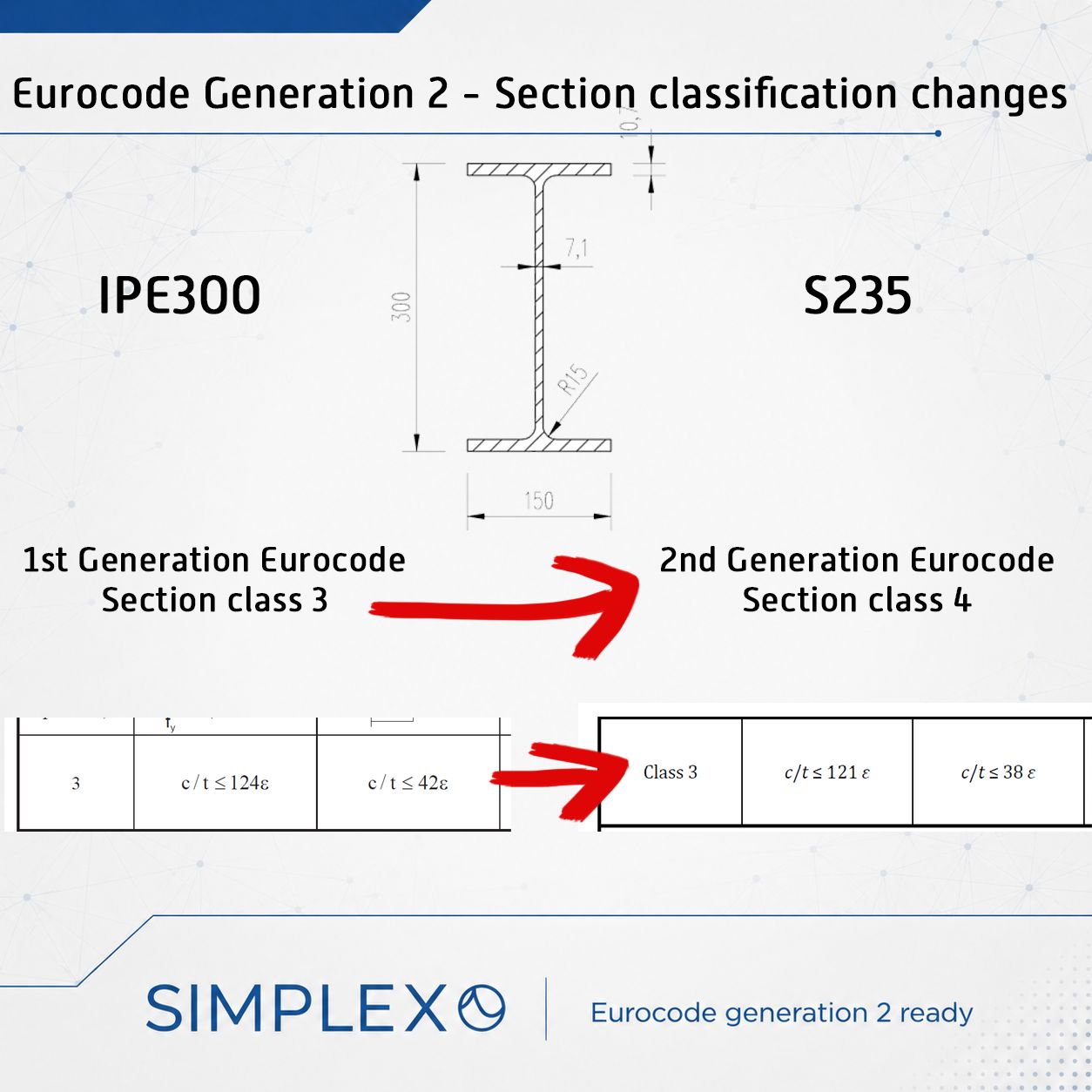
Even small parameter changes can shift classification outcomes.
Take an IPE300 S235 with a web in compression:
- c/t = 39.2
Limits:
- Gen 1 Class 3: 42
- Gen 2 Class 3: 38
→ Result: Class 3 → Class 4
It might look like a minor tweak, but it can significantly affect design resistance and detailing. This isn’t just a table renumbering exercise. It changes real design outcomes.
4. Minimum Reinforcement: From Simple Formula to Behaviour-Based Check
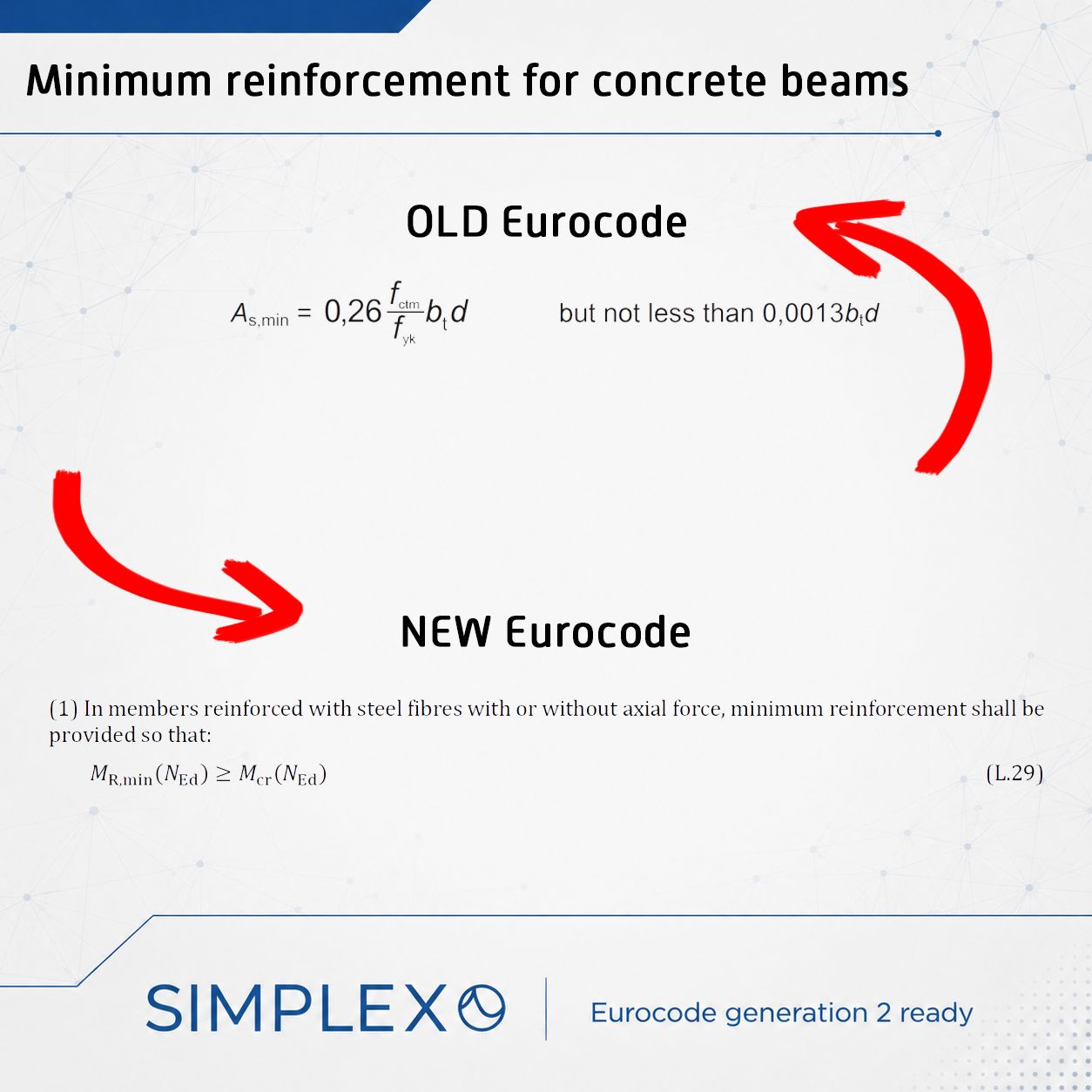
In Eurocode 2 (Gen 1), minimum bending reinforcement was easy to understand and verify:
As,min = max(0.26 · fctm / fyk · bt · d, 0.0013 · bt · d)
Clean, transparent, and straightforward to implement.
In Eurocode Generation 2, things get more advanced.
Minimum reinforcement is now tied directly to section behaviour, meaning it must satisfy:
MR,min(NEd,min) ≥ Mcr(NEd,min)
In other words, the section must have enough resistance compared to its cracking moment, considering the actual axial force state.
The practical consequence?
You can no longer determine minimum reinforcement from geometry and material inputs alone. You first need analysis results, especially axial forces, before you can properly evaluate it.
It’s a more realistic approach, but also a clear step up in complexity.
Eurocode Generation 2 changes – Making It Practical
Eurocode generation 2 changes are all about refinement: more context, more realism, and tighter links between analysis and design checks.
But that also means:
- Less “plug-and-play” formulas
- More dependency on analysis results
- More nuanced inputs
At Simplex, we’re working to balance this by:
- Keeping inputs user-friendly
- Automating calculations where possible
- Making assumptions transparent (no black boxes)
- Allowing full user control when needed
Bottom line: Eurocode generation 2 changes don’t reinvent structural design, but it does make it more behaviour-driven. The changes may seem subtle, but they’re worth understanding early.
“We are working hard to implement the second-generation Eurocodes in both Simplex and FEM-Design, and we are getting very close to completing the standard implementation. The next big question is what the national annexes will bring. One of the goals of the second-generation Eurocodes was to limit the scope of national choices, so it will be very interesting to see whether the different countries can live up to that ambition,” says Isak Bjorhag, Head of 2D R&D at StruSoft.
Stay ahead of the second-generation Eurocodes and understand their direct impact on your structural design workflow. Join us on Thursday, June 11, 2026, 13:00–14:00 CET for a technical webinar on how we’re implementing the updated standards in FEM-Design. Click here to register.